
Automated vs. Manual Warehouse Conveyor Systems: Which Is Right for Your Operation?
Throughput, labor costs, scalability, ROI — here's how the two models stack up and how to decide which one your facility actually needs.
Not Sure Which System Fits Your Facility?
Our Southington, CT team has designed and installed both automated and manual conveyor systems for warehouses, distribution centers, and manufacturing facilities across New England for over 22 years.
The Right Conveyor System Depends on Your Operation — Not a Default Answer
The conversation around automated versus manual warehouse conveyor systems often gets framed as a simple upgrade path — automate everything, as fast as possible. But for most facilities, the real question is more specific: at what point does automation deliver a return that justifies the investment, and what does the right hybrid setup look like in between?
Whether you're evaluating a new installation, planning a phased upgrade, or trying to squeeze more throughput from an existing warehouse conveyor system, this comparison is built to give you a clear framework — not a sales pitch.
We'll break down how each system performs across the factors that actually drive the decision: throughput capacity, labor dependency, upfront cost, long-term ROI, flexibility, and maintenance requirements.
- Side-by-side comparison across 6 key operational factors
- Visual breakdown of automated vs. manual performance differences
- Decision guide: which facilities are best suited for each model
- How to plan a phased automation upgrade path
- What installation and ongoing maintenance looks like for both
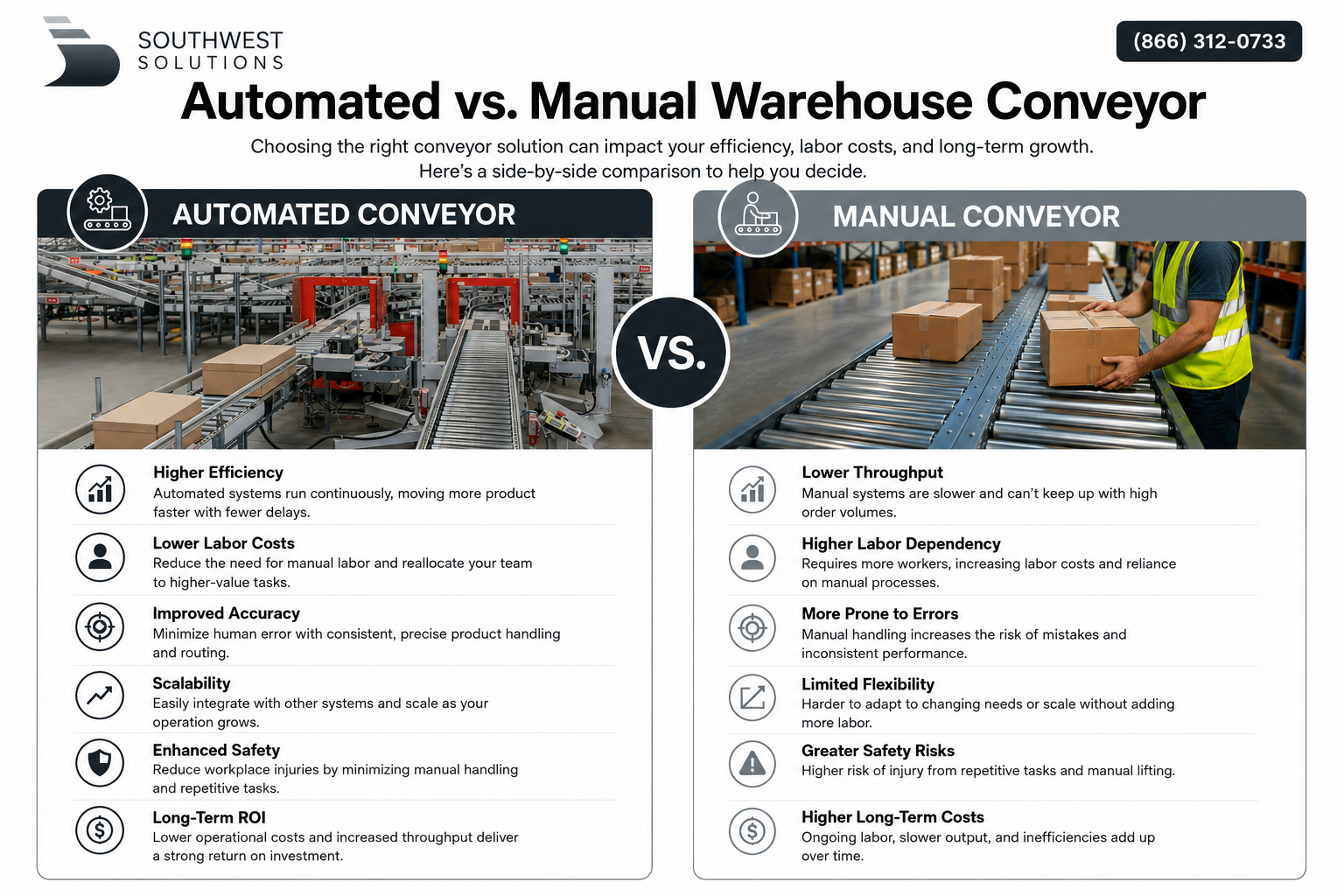
Automated vs. Manual: The Quick Visual
At a glance, here's how the two system types compare across the factors that matter most to warehouse operations managers and facility decision-makers.
How Each System Performs Where It Counts
Every facility is different. Here's a detailed breakdown of how automated and manual conveyor systems compare across the six factors that drive most purchasing and upgrade decisions.
Throughput & Efficiency
How much product each system can move per hour — and how consistently.
Runs continuously at consistent speed. No fatigue, no slowdowns. Throughput scales with system design, not headcount.
Output varies with worker performance and shift staffing. Slower peak throughput and harder to sustain at high volumes.
Labor Dependency
How much your throughput relies on workforce availability and performance.
Significantly reduces per-unit labor. Frees workers for higher-value tasks like quality control and exception handling.
Throughput is directly tied to headcount. Labor shortages, turnover, and absenteeism have an immediate operational impact.
Upfront Cost
The initial investment required to get the system operational.
Significantly higher upfront — driven by powered drives, controls, sensors, and integration. Installation timelines are longer.
Lower initial capital outlay. Gravity roller systems and basic belt conveyors can be installed quickly with minimal infrastructure.
Long-Term ROI
How each model performs financially over a 3–7 year horizon.
Higher ROI at scale. Reduced labor costs, fewer errors, and greater throughput capacity generate returns that compound over time.
Lower ROI at volume. Labor costs remain constant or increase while throughput stays capped, reducing margin over time.
Flexibility & Adaptability
How easily each system adapts to changing product mix or operational requirements.
Harder to reconfigure once installed. Changes to product size, weight, or flow may require engineering and capital investment.
More adaptable. Workers can handle irregular product, change flow patterns, and adjust to new SKUs without system modifications.
Maintenance Requirements
What ongoing service each system demands to stay operational.
More complex maintenance — motors, drives, sensors, controls, and software all require attention. A structured preventive maintenance program is essential.
Simpler maintenance profile — fewer moving parts and no control systems. Routine service is less intensive but still required for belt and roller health.
Automated or Manual — A Practical Decision Guide
Neither system is universally better. Here's a straightforward guide based on the operational characteristics that typically drive the decision.
Go Automated If Your Facility…
- Processes high, consistent order volumes daily
- Runs two or three shifts with continuous operation
- Faces rising labor costs or chronic staffing challenges
- Handles standardized product sizes that move predictably
- Needs to scale throughput without scaling headcount proportionally
- Has the capital budget and a 3–5 year ROI horizon
- Operates in distribution, e-commerce fulfillment, or pharmaceutical
Stay Manual (or Start Manual) If Your Facility…
- Has lower or highly seasonal order volumes
- Moves irregular, oversized, or highly variable product
- Needs fast deployment with minimal capital outlay
- Is early-stage or testing a new warehouse workflow
- Requires high flexibility to adapt to changing SKU mix
- Has limited floor space that constrains automated line design
- Plans to phase in automation incrementally over time
Related Services & Resources
Frequently Asked Questions
What is the difference between automated and manual conveyor systems?
Automated conveyor systems use powered drives, sensors, and control software to move materials through a facility with minimal human intervention. Manual systems — such as gravity roller conveyors — rely on human effort to move product and require more labor per unit of throughput. Automated systems offer higher efficiency and scalability; manual systems offer lower upfront cost and simpler operation for lower-volume facilities. See our automated warehouse conveyor systems page for more detail on what fully powered systems look like in practice.
When does it make sense to automate a warehouse conveyor system?
Automation typically makes sense when a facility processes high, consistent order volumes, operates multiple shifts, faces rising labor costs, or needs to scale throughput without proportionally increasing headcount. Distribution centers, e-commerce fulfillment operations, and pharmaceutical facilities handling standardized product are common candidates. The ROI calculation depends on current labor costs, projected volume growth, and the total cost of the system including installation and ongoing preventive maintenance.
What are the types of conveyors used in warehouses?
Common warehouse conveyor types include belt conveyors for bulk or packaged goods, gravity roller conveyors for manual movement of boxes and totes, powered roller (live) conveyors for automated transport, overhead or chain-driven systems for specialized sorting, and vertical reciprocating conveyors (VRCs) for moving product between floor levels. The right choice depends on product type, weight, throughput requirements, and facility layout. Our team at Affordable Conveyor can assess your facility and recommend the right system configuration.
How much does it cost to install an automated conveyor system?
Automated conveyor system costs vary significantly based on system complexity, linear footage, conveyor type, WMS integration, and facility-specific installation requirements. Simple powered roller systems for smaller facilities may start in the tens of thousands; complex sortation systems for large distribution centers can reach into the millions. A site assessment and engineering review are required for an accurate estimate — contact our team at (860) 342-8753 to get started.
What maintenance does an automated conveyor system require?
Automated conveyor systems require structured preventive maintenance programs covering belt tension and tracking, roller and idler inspections, motor and gearbox monitoring, electrical control system checks, sensor calibration, and lubrication at defined intervals. Because automated systems run continuously and carry higher throughput, maintenance intervals are typically more frequent than manual systems. Partnering with a qualified conveyor maintenance provider for a scheduled PM program is critical to protecting the investment.
Can a manual conveyor system be upgraded to automated?
Yes. Many facilities begin with manual or semi-manual systems and phase in automation incrementally — starting with powered drive sections, adding sensors and divert controls, and eventually integrating full sortation and warehouse management software. A conveyor systems integrator can assess your existing infrastructure and design a phased upgrade path that fits your budget and operational timeline. Our team has handled both greenfield installations and retrofit automation projects across Connecticut and New England.
Who installs automated conveyor systems in Connecticut?
Affordable Conveyor Services, based in Southington, CT, installs automated warehouse conveyor systems for distribution centers, fulfillment operations, and manufacturing facilities across Connecticut and New England. With over 22 years of experience and 11,400+ projects completed, our team handles engineering, installation, electrical integration, and commissioning for both new and retrofit conveyor systems. Call us at (860) 342-8753 or contact us online to schedule a site assessment.
Connecticut's Conveyor Installation & Integration Experts
Whether you're building out a new automated system, upgrading an existing manual line, or somewhere in between — our Southington-based team has the experience to get it right the first time.
Talk to our team
Request a site assessment or reach us directly — we'll help you figure out the right system for your operation.
24/7 Direct Line (860) 342-8753